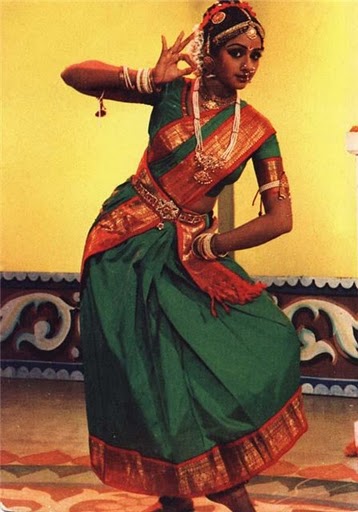
This cover feature on Bhagavata Mela
Natya Vidya Sangam was first published in April 1994 in a Chennai-based
magazine for the arts SRUTI No. 115 (See pages 35-39)
BHAGAVATA MELA IN
MELATTUR
ROLE
OF BHAGAVATA MELA NATYA VIDYA SANGAM
The
following feature was written by Sruti staffer INDU RAMAN, who has been elected
as the chairperson of the Melattur Bhagavata Mela Natya Vidya Sangam. It
complements the feature on Bhagavata Mela published earlier (Sruti 22)
Bhagavata
Mela is a unique blend of dance, drama and music. Practiced by Brahmins from
the 14th century onwards, it came into vogue in Melattur,
Saliyamangalam, Oothukadu, Soolamangalam, Nallur and Teperumalnallur in
Tanjavur district. But it has suffered a steady decline over the decades.
Scholars like E. Krishna Iyer and Mohan Khokar, as well as Rukmini Devi, have
attempted to revive it; yet, it is not exactly flourishing. Today only the
first two and last-named villages are
clinging to the tradition and observing the rituals.
The
tiny two-street village of Melattur has always enjoyed a special status and
received greater attention compared to the other five villages. It has the
pride of being the birth place of Venkatarama Sastri, the author of the
dance-dramas being enacted today. It is believed that the mask in existence today
was worshipped by him.
Melattur
has preserved the tradition of annual performances more regularly than the
other villages. In fact, since 1964, there are two troupes conducting festivals
every summer: the Lakshmi Narasimha Jayanti Bhagavata Mela Natya Nataka Sangam,
which enjoys greater recognition and local support and is led by Dubai based S.
Natarajan; and the Melattur Bhagavata Mela Natya Vidya Sangam led by Bharatam
R. Mahalingam. The two factions have existed independently for 30 years. A
competitive spirit prevails between the two groups, but it augurs well for the
tradition, in as much as, in the long run, this spirit will help to foster
their common goal of maintaining the tradition.
The Natya Vidya Sangam
The
bhagavatars of Melattur have kept alive a 500-year old tradition through this
living ritual of faith. They have nurtured a dance-theatre as close as possible
to its original form. Resisting change, struggling to survive, but steadfast in
faith. The Bhagavata Mela Natya Vidya Sangam has conducted an annual festival
for 29 consecutive years, in recent years at the Balu Bhagavatar Memorial open-air
auditorium just outside the village. Somehow, this group has hardly received
any recognition from the media and public. Nonetheless, it has been
concentrating on improvements to the dance and training more youngsters to
continue the tradition. This year it will stage the new production Seetha Kalyanam, for the first time on 22 May, followed by Prahlada Charitram the next day, which
is Narasimha Jayanti.
The Bhagavatulu
The
dance-actors of the Bhagavata Mela Natya Vidya Sangam are all amateurs; their
professional interest lies elsewhere. Bharatam R. Mahalingam (Mali), its chief
dancer and lead actor, is the village administration officer. S. Gopalakrishnan
(Gopu) gave up a job as an accountant to become its Secretary. S. Nagarajan is
a sales person who has requested a transfer to Thiruchi from Bombay so that he
can practice dance more often. R. Subramanian is a Customs officer. They all
converge at Melattur at least two weeks before the annual festival, so that
they can rehearse their roles.
Mali
is the nephew of P. K. ‘Melattur’ Subbier, a disciple of Ariyakudi Ramanuja
Iyengar. Subbier was the main musician and moving spirit behind the group till
his death two years ago. His brother P.K. Ramalingam (92), Mali’s father, was a
source of inspiration and unifying factor till his demise in October 1993. Mali
had his debut as Prahlada when he was seven. He grew into the female lead, as
Rukmini, Parvati and other characters. He is endowed with a highly mobile face
and his large eyes are a vehicle for the subtle expression of fleeting
emotions. Last year he made a smooth transition to male leads- as Hiranyakasipu
and Harischandra. The dramatic, masculine histrionics come easily to him. His
abilities are evident when he helps fellow dancers to bring out their best.
Even rehearsals become an intense spiritual experience when he takes the floor.
He is still reticent about dialogue delivery. If he would overcome this hurdle,
the quality of his performance should be splendid.
R.
Subramanian (Mani) and S. Nagarajan pull off their female roles with great
aplomb. Mani’s Bhooma Devi in Prahlada
Charitram is an essay in dignity. Looking as though he has stepped out of a
Ravi Varma painting, he executes his pravesa daru and a teermanam flawlessly
and with grace. One never suspected that he could score in abhinaya as well,
but what a charming, mischievous Matanga kanya he makes, attempting to seduce
the noble Harischandra!
In
fact, this is one scene which illustrates the fact that spontaneity is one of
the strong points of Bhagavata Mela Natakam. Two Matanga kanya-s are sent by
Vishwamitra to test Harischandra’s character. As the guards try to chase them
away, the girls run around trying to reach the king. Chandramati is horrified
and protectively shields her husband while shooing the two away. There is much
running around, confusion, feminine mischief and frivolity in this scene. The
action-reaction sequence is spontaneous, and the better for not being rehearsed
painstakingly.
A
major talent discovery is S. Nagarajan, a government-scholarship holder for
training in Bharatanatyam. He is performing the lead female roles this year. He
has a finely chiselled facial structure which seems masculine enough, until one
sees him transformed in a women’s costume. Moreover, in his performance, there
are no self-conscious mannerisms to emphasise femininity. Only 21, he has been
learning dance under Guru Herambanathan for four years. His roles have
therefore built into them the most intricate alarippu-s, teermanam-s and
tillana-s that his teacher can compose. His patrapravesam as Leelaavati (Prahlada Charitram) begins with a strenuous
tiraseela (curtain) composition replete with mandi adavu-s. This is followed by
a chatusra alarippu and a teermanam. Nagarajan goes through this demanding
introductory scene with precision and practised ease.
Nagarajan’s
abhinaya is subtle and restrained. In the sequence where Leelavati uses her
charms to deflect Hiranyakashipu from the wrong path, he displays sringara in all its nuances. His
portrayal of Chandramati (Harischandra)
a noble queen, mother and devoted wife, shows a deep understanding of a women’s
psyche. This is an achievement for one so young, considering especially that
this role makes a heavy demand on his ability to sustain the sthayi bhava of karuna as the queen faces her travails.
Nagarajan is also well-versed in music and nattuvangam, making him the pride of
his doting guru. His approach to Bhagavata Mela is serious and his religious
fervour gives an intensity to his performance. He is a dancer to be watched.
Gopu
and Kannan are the two others who enliven the natakams. Neither of them is a
dancer but they represent the natya or dramatic element where articulate
dialogue delivery is an essential element.
G.
N. Chandramouli, who has re-joined the troupe after six years, is another
youngster who is a well-trained dancer. He has a fine stage presence, and is
impressive as Krishna or Siva.
There
are, too, young boys like R. Gopi, a dancer-actor who can deliver dialogues as
well as do comedy roles, or charming female impersonations. At 19, he has also
to work for his living, and squeeze in a study programme to better his job
prospects.
The music
The
high point of Bhagavata Mela Natakam is music. A senior contemporary of the
Trinity of Carnatic music, Melattur Venkatrama Sastri has succeeded in
extracting every ounce of rasa from the raga-s. The splendiferous rakti raga-s becomes
an ideal medium for the lucid Telugu lyrics. An astounding variety of literary devices
like daru, dwipada, sisapadya, prose and jati are combined imaginatively. The
music has instant appeal.
The
compositions- kriti-s, pada-s, etc. - mostly in madhya laya or vilamba laya, are
simple in structure and effective. Some kritis-s are instantly identifiable as
the model for the more popular kritis composed by the Trinity. For example, the
mettu of Sree Rajagopala in Kurinji,
composed for Parvati Kalyanam and
that of Sree Venugopala composed in
the same raga by Muthuswami Dikshitar are identical. In the same drama, a piece
in Keeravani is identical to Thyagaraja’s Kaligiyuntey.
One does wonder which came first, the mango or the seed?
The
exposition of a dance-drama in its complete version lasts about four hours. A
contingent of five singers takes on the responsibility of non-stop singing.
There are two main singers, others specialise in singing an introductory
alapana or the dwipada-s only, as they are not bound by complicated rhythm or
dance. The extra singers help in maintaining the momentum and support the long
repetitions during elaborate sanchari-s excuted by the dancer. The orchestra
usually includes a mridanga, a flute and a violin or harmonium.
The
music section of the Bhagavata Mela Natya Vidya Sangam is led by the veteran Thanjavur
L. Venkatesa Iyengar. He has been associated with the group for the past 30
years. Age has diminished only his stamina; he has retained his voice as well
as chaste fidelity to tradition. Iyengar was recently felicitated by rasika-s
and students for completing 50 years of service to music.
The
major responsibility of singing for the natakams rests with S. Radhakrishnan,
an established teacher and a concert musician. Radhakrishnan has been
associated with Melattur and Saliyamangalam natakams for over 30 years. His
old-school rendering of these kriti-s is in refreshing contrast to contemporary
trends. He is able to sustain the sense of drama and devotional fervour which
are integral to the whole experience.
N.
Srinivasan, Sanskrit scholar of the Saraswati Mahal Library, is a Harikatha
exponent. His bell-like voice has a true ring and he sings the dwipada-s with
clarity and expression. K. Sivasubramanian is another stalwart member of the
music team, while a recent addition to it is Mannargudi V. Muthuraman who has a
voice rich in emotive power.
Veteran
flutist T. R. Navaneetham, and N. Saktivadivel, son of Morsing Natesa Pillai,
lend solid support to the team.
S.
Viswanathan, a Telugu scholar recently retired from the Saraswati Mahal
Library, is serving as a guide, advising on correct pronunciation and
clarifying lyrics and dramatic situations.
N.
Kailasam, another nephew of Subbier, actually controls the entire production in
his capacity as Director. He is well-versed in music and dance and has a
thorough knowledge of all the natakams.
A
word about the costumes and the make-up would be appropriate at this juncture.
T. K. Venguduswamy has several years of experience in make-up, costume and
stage settings. He has with economy and innovation produced the special effects
required by dance-dramas like Prahlada Charitram,
Harischandra and Parvati Kalyanam.
There
is a danger that the natakams will lose certain features and specialities
because of the eagerness of the Sangam to earn acceptance of the modern, urban
audience. Konangi, the buffoon, is important to the natakam but has lost its
earlier importance. Today he merely circumbulates the stage with a few steps,
but earlier, he was probably expected to conduct a conversation with the
Sutradhara to introduce the story. It is essential that the natakams maintain
their completeness. Kathakali and Kuchipudi have yielded to urban impatience
and truncated their performances, losing several valuable aspects in the
bargain. Bhagavata Mela Natakams are not performances meant for entertainment;
their strong emphasis on religious rituals is an important aspect, as is
audience participation. The dancers are not professional performers. One cannot
expect polished, sophisticated presentations from them. However, the spirit
that enthuses them to learn, rehearse and perform pervades the atmosphere, and
touches the spectator’s heart. The dancers, after all, are not on the stage
hankering after fame or money. They do not get paid for their trouble. The
musicians, who are paid, are professionals but they often sacrifice other
lucrative engagements like recordings to be a part of the festival. The entire
team lives together like one family for a month.
The
main problem they face, besides insufficient finance, is the non-availability
of young boys who are willing to learn the roles and commit themselves to the
natakams. There are two parameters which have to be fulfilled by aspirants-
they must be Brahmins and must be natives of Melattur itself. This is now being
fulfilled by recruiting young boys to play Prahlada, the roles of his playmates
and other children in the various plays. But there is no systematic
indoctrination or training facility available right now. The same is true of
musicians. A second line of vocal support must be trained to ensure continuity.
Thus is becoming increasingly difficult as the sheer volume and variety of
texts to be learnt is formidable. The stamina and staying power required to
sing for four hours every evening for a week can be generated only be devotion
and dedication to the cause.
This
year, the central Sangeet Natak Akademi has enhanced its annual adhoc grant. In
recognition of the importance of the Bhagavata Mela festival held in Bombay in
January, SNA gave a generous grant of 25.000 rupees to pay honorarium to all
the artists. The scholarship awarded by the Government to deserving youngsters
was given to S. Nagarajan, the most promising performer. The urgent need is to
generate additional funds, hold down expenses and become self-sufficient.
Furthermore, the troupe needs more performance opportunities to ensure that the
members are reactivated and feel motivated enough to keep the tradition alive.
The Myth of Narasimha’s Mask
The
most striking factor in the Bhagavata Mela Natakam is the mask of Narasimha
used in the climactic scene of Prahlada
Charitram.
Although
there is rich epigraphic evidence concerning dancers, musicians and
instrumentalists who play a predominant role in religious practices, definite
data regarding drama has not been available. Drama as an art-form is believed
to have grown out of the primitive rituals. This is true of India as well as of
Greece, Japan and the European countries. “In the Dionysian cult, the main
feature of worship is a procession of dancers intoxicated by wine and wearing
animal masks” says Prof. S. K. Ramachandra Rao. “Wearing a mask symbolised that
the dancer was possessed by that animal or god whose mask he was wearing.”
The
mask of Narasimha in Melattur is believed to be the one worshipped by
Venkatarama Sastri. It has a cream-coloured face and a crown that is decorated
with the typical Tanjavur mosaic pattern of small gold, green and red
triangles. Fairly large and imposing, it is kept in a glass cupboard near the
sanctum sanctorum. On the morning of Narasimha Jayanti, the actors participate
in a special prayer at the Vadaraja Perumal temple. After the various ablutions
are offered to the utsava moorti, the mask is worshipped with flowers and arati
of camphor. In the evening, the mask is brought to the venue in a small
procession carrying the idol and placed directly opposite the stage at the far
end. A few minutes before the climax, a trusted person carries the covered mask
to the green room where the actor wears it. The actor’s privilege of wearing
the mask has been handed down to him by his ancestors. He observes a fast
during the day and once the mask is worn, is transformed into an apparition
full of fury. He tries to break past the wary helpers who hold him back with
the help of sashes strung around his waist and arms.
This
is a phenomenon that never fails to capture the imagination of the devotees.
The lives of the people of Melattur are irrevocably intertwined with Narasimha,
and they believe the deity blesses them in spirit every year by entering the
body of the actor.
Many
weird tales are related by the locals.
·
“He dragged four of us who were holding
him, as well the heavy throne on which he was seated, right to the middle of
the stage. Some strange power seems to have given him the extraordinary
strength to do so”!
·
“We could once hear four different voices
emanating from him.”
·
“The only palliative for Narasimha is jaggery
water or paanagam. It has to be made by one who has been purified by a ritual
bath. No one else must taste or touch it. Once a child had unknowingly tasted
it. The god would not accept it. We could not calm him at all until a fresh
pitcher was prepared.”
·
Only a few years ago, a real-life enmity
ended on the stage, when the Swami actually tore open his opponent’s torso.
This happened in Soolamangalam where the deity is an ugra deivatam or an angry one. Ever since then we avoid a direct
confrontation in Melattur.
An
eyewitness of this horrifying incident shudders as he recalls it.
This
time, the actor who played Swami was in convulsion even as the procession led
him back to the temple with loud chanting of “Jai Narasimha, Sree Narasimha”.
The mask was reverentially taken out and replaced in the cupboard and its doors
shut firmly. The man had fainted in the meanwhile, and after being fed more
paanagam, he came out of the trance totally innocent of what had transpired.
In
Saliyamangalam, the mask is much smaller and predominantly white. The mask is
kept at the home of a bhagavatar where it is worshipped along with idols of
Rama, Seeta and Lakshmana. Although there is direct confrontation between
Narasimha and Hiranyakasipu, much care is taken to prevent any untoward
incident.
Prahlada Charitram In Saliyamangalam
Saliyamangalam
lies 15 kilometres east of Tanjore on the way to Nagore. The dance-dramas
performed here were written here by one Panchanatha Bhagavatar, who is also
credited with Vipranarayana, Rukmangada,
Rukmini Kalyanam and Seeta Kalyanam, besides Prahlada Charitram for
presenting an intensely ritualistic ritualistic version of which the village
has become has become famous. The local deity is Sreenivasa who appears here
with his consorts Bhoodevi and Sreedevi.
The
bus stops on the main road and a 10-minute walk on the dusty dirt-path takes us
through the village to the agraharam. We were late by a few minutes and we
could hear the music on the loudspeakers long before we actually reached the
enclave. The narrow street was crammed with an assorted audience of men, women
and children seated on the ground. On either side were houses built
wall-to-wall, their Malabar-tiled roofs sloping right down over the pyol
(tinnai) on which some were sleeping and others sprawled in various positions
of languorous ease. All eyes were riveted on the stage where an elderly man
held the hands of a little boy lost behind an enormous Ganesa mask. He
conducted him through his mandatory steps. The stage was the far end of the
street, directly opposite the utsava moorti or processional deity placed at
this end.
The
play commenced with the actor (S. Srinivasan), clad in a white dhoti and a
kurta, rendering abhinaya to the traditional sabdam. The sabdam in a Bhagavata
Mela Natakam is one of the preliminary compositions which introduce the play,
the composer and the story to be enacted that night. It is sung in Kambhoji,
with jati phrases in between stanzas, identical to the item performed by
today’s Bharatanatyam dancer.
The
stage was pathetically small, and had a red curtain which was pulled across
after every scene. The major portion of the stage was occupied by a large
contingent of vocalists, the nattuvanar, the mridanga player, the other
accompanists and the prompters. The centre stage was blocked by an old
rexine-covered two-seater sofa which doubled as a throne for the king. Only the
main actors, portraying Hiranyakasipu, Prahlada and Leelavati, wore full
make-up. The others wore costumes and no make-up. There were no wings at the
side; the pyol of the adjoining house served as a green room.
Strangely,
none of this apparently unsophisticated ambience distracted the viewer or
dampened the general spirit of the performance. Even when the nattuvanar who
was conducting the drama got up and walked away for an inevitable break, the
dancer enacting Leelavati was prodded and prompted on by others in the
orchestra to complete the sequence.
A
few interesting observations. The kattiakaran- the person who announces and
then introduces at length the various characters in a play- announced the
arrival of king with the final warning in Hindi: “Maharaja Hiranyakasipu
padhaar rahen hai.” An interlude featuring a panchangakarar (almanac reader) is
a peculiarity of the Saliyamangalam tradition. The dialogue was spoken in
Tamil. A few jokes served as comic relief, and touched current topics like
water scarcity. These were highly appreciated by the audience.
While
the music contained mainly Ghana raga-s, the lyrics had a fair sprinkling of
colloquial phrases. One song in particular seemed very familiar, but I could
not place it for some time. When I did, I was heartily amused. The mettu was
the same as that for the unforgettable super hit from the Tamil film ‘Miss
Mary’- Brindavanattil Nanda kumaran….!
The
Saliyamangalam natakam was dominated by the role of the evil king. Powerfully
played by Srinivasan, it was a case of near total identification with the role.
In his portrayal, one could discern his deep understanding of the scriptures
and tireless dedication. The play kept him on his feet, in a suspended state of
high strung emotion, for almost six hours. Tall and well-built, he wore his
demon-fangs and wielded his club like a natural. His stentorian voice ideally
suited the character, and eloquent lines in Telugu and Sanskrit were a high
point that night; he ad-libbed most of the time. His sense of drama, ability to
sustain a mood, and realistic acting kept alive the interest of the audience.
Some Facts
The Bhagavata Mela tradition is
among the few surviving links to ancient theatre
·
The compositions, music and dance
as rendered are of very high order.
·
Only males portray the female
roles
·
All dance-actors are amateurs
engaged in different professions in different parts of India, one even
abroad. They assemble at Melattur at their own expense
·
As the nataka-s are presented on
the stage, the viewers and the actors lose their individual identities as
they are transformed into devotees surcharged with emotion praying for the
blessings of Sree Sri Narasimha.
|
Prahlada
was a perfect anti-thesis of his father. In a role that is almost as demanding,
the 14-year old actor remained serene and calm. Not a muscle moved on his face,
but he wore an intensely spiritual aura about him.
Leelavati,
as expected, had several Bharatanatyam sequences, but did not have a tiraseela
(curtain) entry. The female roles need especially careful make-up application,
which was lacking in this case. But the actor acquitted himself adequately in
his role. The climax of the drama occurred when Hiranyakasipu tauntingly
shouted, “Prahlada, is your Narayana in this?” while striking a pillar angrily.
“Yes, my father”, replied Prahlada. Here, actually everything came to a sudden
stop, an anti-climax. The curtain was pulled across, an interval was announced,
and the audience shuffled to its feet. It was 4 am. All those who were sleeping
were shaken awake. One was puzzled by a slurry of mysterious activity.
The
members of Srinivasan’s family who were conducting the festival purified
themselves with a bath. The lady of the house then prepared several litres of
paanagam, beverage of water mixed with jaggery and spice. The audience gathered
on either side, leaving a long narrow passage from the stage to the shrine
where the utsava-moorti was kept.
Meanwhile
the musicians standing in a group at the far end began to sing the ‘stambha strotra’,
eulogising Vishnu and enumerating various legends of the miracles wrought by
him. For almost an hour Prahlada danced, unmindful of the confusion all around
him. There was an air full of expectancy. Many devotees had brought white
garlands as offerings to Narasimha-swami. A four-board partition was held
together by a few men and the actor who did this role was quickly led into this
enclosure. Prahlada continued to dance, walking up and down the passage,
addressing the idols in front of him. Now Hiranyakashipu joined him and loudly
berated Vishnu.
The
story has it that Narasimhaswami appeared at twilight, so now there was a
slight lull in the activity, as the actors waited for the auspicious moment.
Subsequently, two helpers held up a two-piece plywood pillar in front of the
enclosure. The moment had come.
Several
things miraculously happened at the same time. The garlands hung over the top
of the enclosure disappeared, causing some to exclaim: “Swami has worn the
garlands.” Fireworks were set off, the pillar split open and, amidst smoke and
spiritual chanting, Narasimhaswami rushed forth. A truly hair-raising moment.
Dressed in voluminous white skirting, a white Narasimha mask, and several
garlands, the actor thrashed about uncontrollably. A small stool was brought
and he was helped to it down. Four men stood cautiously by his side, holding
him down.
The
musicians split into two groups, and a wordy duel between Hiranyakasipu and his
divine nemesis commenced. Unfortunately, the words and the music were quite
lost in the general noise. As the audience settled down to get a better view,
the two walked backwards and forwards with an air of belligerence. The
spectators were quite involved and transported into an esoteric trance by the
proximity of the other-worldly figures in their midst. The vain king became
bolder and bolder. Fighting the men who held him back, Hiranykashipu suddenly
drew his sword and lunged dangerously close to his weird-looking enemy. Someone
quickly took the sword out of his hands. Now the king demanded his club and,
swinging it, showered stinging remarks and unveiled threats with reckless
bravado. Most of the dialogue was based on the various myths.
Finally,
the distance between the antagonists was reduced and the man-lion grabbed the king
and literally dragged him to his seat. An actor dressed as Bhooma Devi stayed
close to him and the three were enveloped in a white dhoti concealing them for
a minute or so. When the screen was removed, the king had fainted and was now
carried away. From the mouth of the mask hung red ‘intestines’. The entire
audience chanted, “Jai Narasimha, Sree Narasimha”. Strains of Bhoopalam played
on the nagaswara floated melodiously in the air. Arati was shown, and pots of
paanagam were fed to the swami, still convulsing with fury. The crowd
dispersed. It was six O’clock in the morning.